

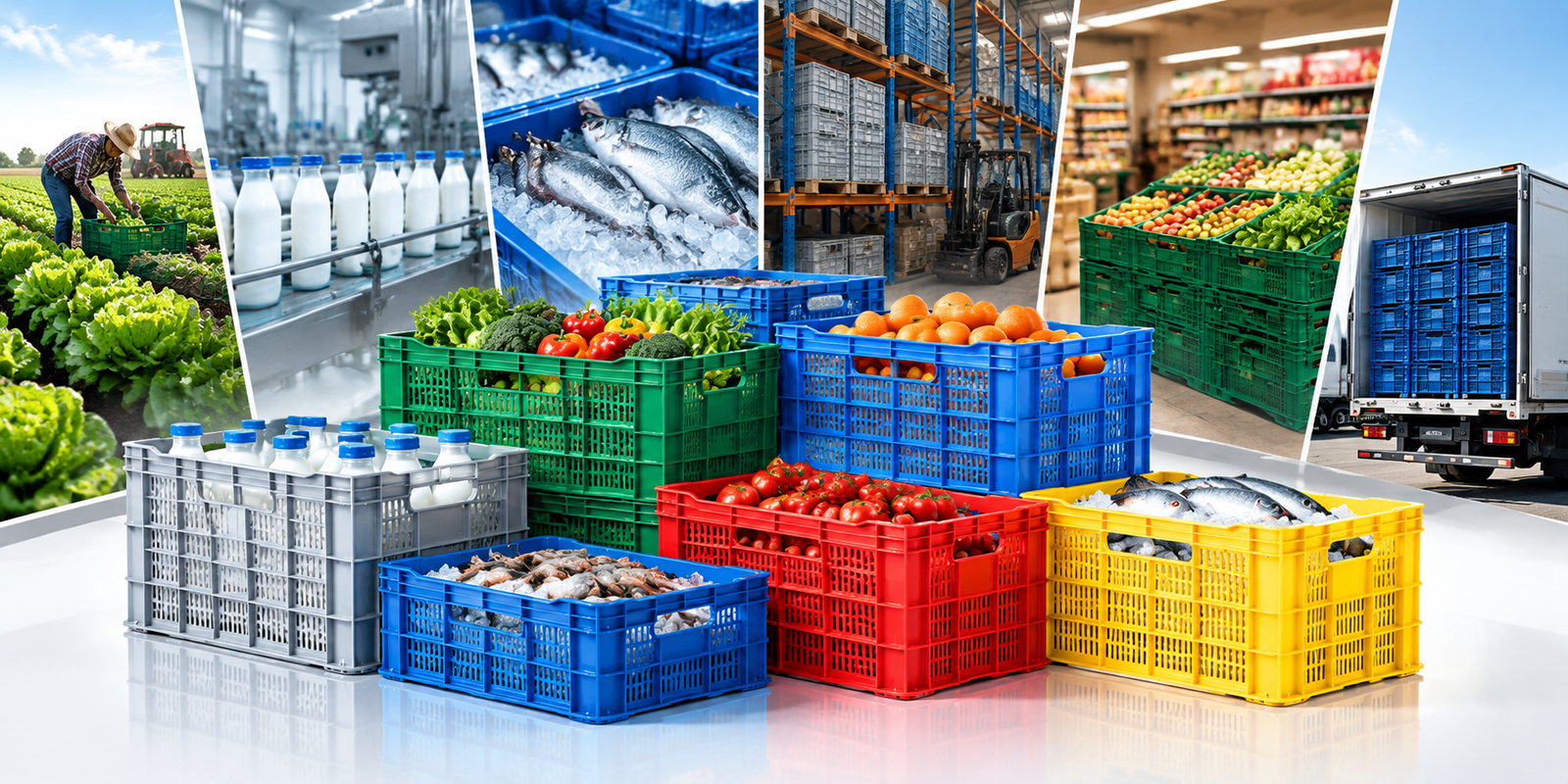
Plastic crates are reusable containers designed for storing, handling, and transporting goods throughout the supply chain. They are widely used in agriculture, dairy distribution, seafood processing, grocery retail, food manufacturing, and industrial logistics.
Compared with disposable cartons or untreated wooden containers, plastic crates can offer consistent dimensions, washable surfaces, moisture resistance,e and reliable stacking. However, the right crate must still be selected according to the product, load, temperature, ventilation and handling method.
Why Are Plastic Crates Used in Supply Chains?
Plastic crates help businesses move goods between production facilities, warehouses, distribution centers and retail locations. Depending on their design, they can protect products, improve airflow, simplify cleaning and make better use of available storage space.
Their principal operational benefits include:
- Reusable construction for repeated transport cycles
- Stackable designs that improve warehouse organization
- Moisture-resistant surfaces that are easier to wash
- Vented or solid-wall options for different products
- Standardized dimensions for efficient handling
- Nestable and foldable designs that reduce empty-return volume
- Smooth internal surfaces that help protect packaged goods
- Options for colors, labels, logos and identification systems
These characteristics make plastic crates particularly useful in closed-loop supply chains where containers are collected, cleaned and reused.
1. Agriculture and Fresh Produce
Agriculture is one of the most common applications for ventilated plastic crates. Farmers, packhouses, exporters and produce distributors use them to handle vegetables and fruit from harvesting through grading, cold storage and delivery.
Open-grid sidewalls allow air to circulate fresh produce. This can help cool and prevent heat from becoming trapped inside the container. The rigid structure also provides more consistent protection than flexible bags during stacking and transportation.
Typical products include:
- Leafy vegetables
- Tomatoes and peppers
- Citrus fruit
- Apples and pears
- Grapes and berries
- Root vegetables
- Seeds and packaged agricultural supplies
For fresh produce, buyers should consider ventilation, internal dimensions, stacking strength and compatibility with cold rooms or palletized transport.
2. Dairy Distribution
Plastic crates are commonly used to transport milk bottles, dairy containers and other packaged products between processing plants, distributors and retail stores.
Dairy distribution often requires containers that can withstand repeated handling and washing. Plastic milk crates provide a rigid structure that helps keep bottles upright and separated during transportation. Their open construction also makes the products easier to inspect and handle.
When choosing dairy crates, operators should check bottle compatibility, crate height, handle design, stacking stability and the cleaning process used at the facility.
3. Seafood and Fishing Operations
Seafood processors and fishing businesses use plastic crates to handle fresh fish, shellfish and packaged seafood. These environments frequently expose containers to water, ice, salt and low temperatures.
Plastic crates do not absorb moisture in the same way as untreated wood or cardboard. Smooth, washable surfaces can also make routine cleaning easier. Vented crates allow drainage, while solid containers may be more appropriate when liquid retention or leakage control is required.
Important selection factors include:
- Drainage configuration
- Resistance to low-temperature conditions
- Load capacity when filled with ice
- Ease of cleaning
- Compatibility with cold-chain equipment
- Food-contact material requirements for the target market
The crate itself does not replace temperature control. Seafood must still be handled according to the appropriate cold-chain and food-safety procedures.
4. Fruit and Vegetable Warehousing
After harvesting, fruits and vegetables may pass through several stages, including sorting, washing, packing, refrigeration, and delivery. Stackable plastic crates make it easier to organize these products during each stage.
Because the crates have consistent external dimensions, they can be arranged systematically in warehouses and loaded onto pallets or vehicles. Reinforced corners and stable stacking features help reduce container movement during storage.
Foldable produce crates can also reduce the amount of space required when empty. This makes them useful in returnable packaging systems where empty crates must be transported back to farms or packing facilities.
5. Grocery Stores and Retail Distribution
Supermarkets, wholesalers,s and grocery distribution centers use plastic crates to move packaged food, beverages, household products, ts and other retail goods.
Crates can be prepared in a distribution center and delivered directly to individual stores. Once unloaded, they can be nested or folded for the return journey. This can simplify store replenishment while reducing dependence on disposable secondary packaging.
Common applications include:
- Store order picking
- Shelf replenishment
- Beverage distribution
- Packaged food handling
- Bakery delivery
- Convenience-store distribution
- Warehouse inventory organization
Label holders, barcodes, RFID tags and color coding may be added to support identification and inventory control.
6. Food Processing and Commercial Kitchens
Food processors, bakeries, central kitchens and catering businesses use plastic crates for ingredients, packaged products, trays and utensils.
Solid-wall crates can help contain small items or packaged ingredients, while ventilated models are more suitable when airflow or drainage is required. Attached-lid containers may be used when products require additional protection from dust or handling exposure.
For food-related applications, buyers should verify whether the material and manufacturing specifications are suitable for the intended type of food contact and destination market.
7. Manufacturing and Industrial Logistics
Plastic crates are not limited to food and agriculture. Manufacturers use industrial plastic crates to store and transport components, tools, spare parts, and work-in-progress materials.
Stackable crates can create orderly storage locations along production lines. Attached-lid containers help protect components during inter-facility transport, while divider systems can keep smaller parts separated.
Typical industrial applications include:
- Automotive components
- Electrical parts
- Hardware and tools
- Assembly-line materials
- Spare parts
- Textile products
- Warehouse order picking
- Reusable inter-factory logistics
For heavy industrial products, load capacity and structural reinforcement should be confirmed before ordering.
Which Plastic Crate Is Right for Your Application?
Different products require different crate structures.
| Crate type | Suitable applications | Primary advantage |
|---|---|---|
| Vented plastic crates | Fruit, vegetables and seafood | Airflow and drainage |
| Solid-wall crates | Small parts and packaged goods | Product containment |
| Stackable crates | Warehouses and production lines | Stable loaded storage |
| Nestable crates | Retail and distribution | Reduced empty-return space |
| Folding crates | Agriculture and closed-loop logistics | Compact return transport |
| Attached-lid containers | Industrial parts and valuable goods | Integrated product protection |
| Food-handling crates | Dairy and food processing | Washable, controlled handling |
How to Choose Industrial Plastic Crates
Before requesting a quotation, provide the supplier with the following information:
- Product being stored or transported
- Required internal and external dimensions
- Weight loaded into each crate
- Need for ventilation or solid walls
- Stacking and nesting requirements
- Operating and storage temperature
- Manual, conveyor or forklift handling method
- Food-contact or market-specific requirements
- Required quantity and delivery destination
- Logo, color, label or tracking requirements
Load capacity should always be confirmed under the actual stacking, temperature and handling conditions. A headline capacity alone may not represent every operating environment.
Frequently Asked Questions
What are plastic crates mainly used for?
Plastic crates are primarily used for reusable storage, material handling and transportation. Common industries include agriculture, dairy, seafood, grocery retail, food processing and manufacturing.
Are plastic crates suitable for fruit and vegetables?
Ventilated plastic crates are commonly used for fresh produce because their open-grid construction supports airflow and drainage. The correct ventilation level and crate dimensions depend on the produce being transported.
Can plastic crates be stacked?
Many industrial plastic crates are designed to stack when loaded. Buyers should verify the stacking load, crate compatibility,y and storage conditions before use.
What is the difference between stackable and nestable crates?
Stackable crates remain stable when placed on top of one another. Nestable crates fit inside each other when empty, reducing the space required for return transportation. Some containers combine both functions through a rotating or folding design.
Are plastic crates reusable?
Most industrial plastic crates are designed for repeated handling cycles. Their service life depends on material quality, load, temperature, impact exposure, cleaning method, and operating conditions.
Find the Right Plastic Crate for Your Supply Chain
The most suitable plastic crate is determined by what you transport, how the crate is handled,d and where it will be used. Ventilated crates support fresh-produce distribution, solid crates contain small goods, and folding or nestable models help reduce empty-return space.
Enlightening Plast supplies stackable, ventilated, folding and attached-lid plastic crates for agricultural, food-handling, retail and industrial applications. Send us your required dimensions, load, quantity, application and destination to receive a suitable product recommendation and quotation.