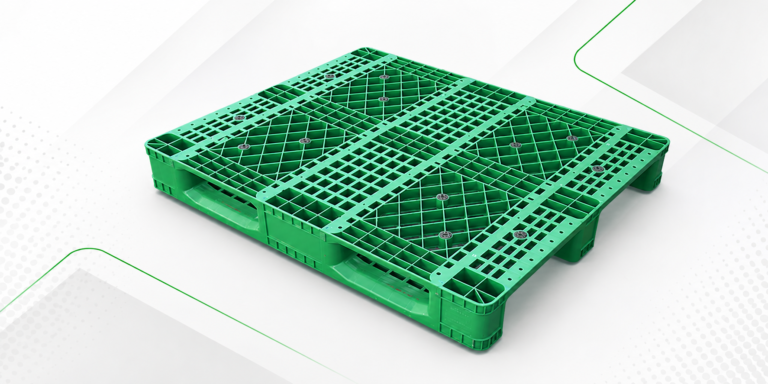

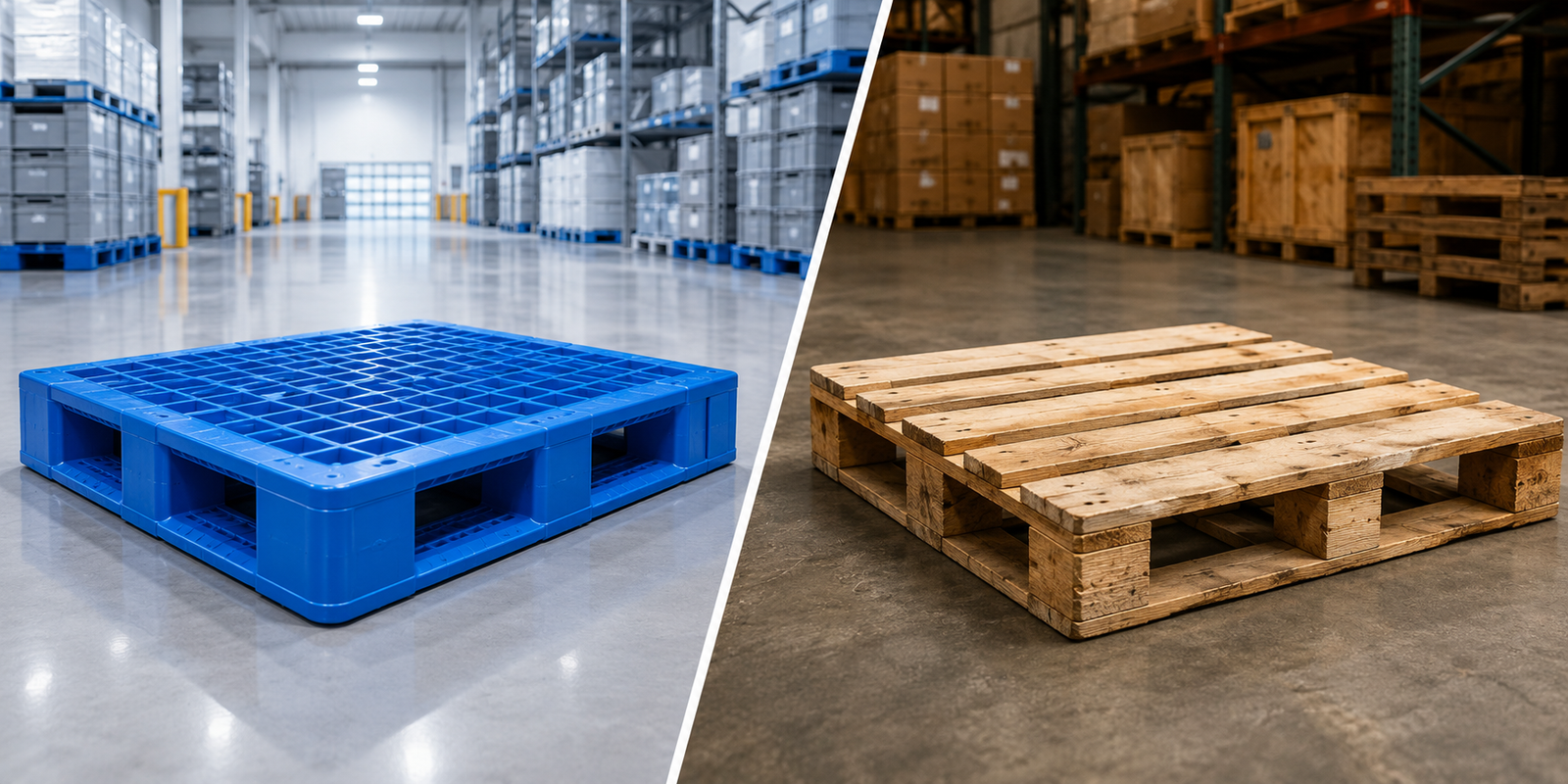
Plastic and wood are the two most common pallet materials used in warehousing, manufacturing and international logistics. Both can support efficient material handling, but they behave differently when exposed to moisture, repeated forklift cycles, cleaning, automated equipment and export requirements.
Wood pallets often attract buyers with a lower initial price and widespread availability. Plastic pallets usually require a higher upfront investment, but their consistent structure, washable surface and suitability for repeated circulation can create better long-term value.
The correct choice therefore depends on how the pallet will be used—not simply which option costs less on the first order.
Plastic vs Wood Pallets at a Glance
| Comparison factor | Plastic pallets | Wood pallets |
|---|---|---|
| Initial cost | Usually higher | Usually lower |
| Dimensional consistency | More consistent | Can vary between boards and repairs |
| Moisture resistance | Does not absorb water like untreated wood | Can absorb moisture and change shape |
| Cleaning | Washable surface | More difficult to clean thoroughly |
| Nails and splinters | None | May develop during use |
| Repair | Usually replaced or professionally repaired | Often repairable locally |
| Export preparation | Generally outside ISPM 15 wood-treatment rules | May require treatment and marking |
| Automation | Consistent shape supports controlled systems | Damaged boards may create variation |
| Best use | Repeated and controlled circulation | Low-cost or one-way shipping |
Load capacity should always be confirmed from the individual pallet specification. Material alone does not determine static, dynamic or racking performance.
Purchase Price or Cost per Trip?
Wood pallets are often less expensive to purchase, making them practical for one-way shipments or routes where pallets are unlikely to be returned.
However, the initial price does not show the complete operating cost. Procurement teams should also consider replacement frequency, product damage, cleaning, downtime and the number of completed trips.
A plastic pallet may cost more initially, but it can provide more predictable performance in a closed-loop system. It does not have boards that loosen, nails that protrude or splinters that damage cartons during normal circulation.
When pallets are regularly recovered and reused, cost per trip is usually a more useful measurement than purchase price alone.
Durability and Dimensional Stability
Wood is a natural material. Its condition can change because of moisture, drying, impact and repeated repairs. Damaged boards or blocks can also change the way a pallet contacts forklift tines, conveyors and storage equipment.
Plastic pallets are manufactured to a controlled shape, providing more consistent dimensions from one unit to another. This can be valuable in warehouses where pallet position, runner spacing and deck height affect handling accuracy.
Plastic does not absorb moisture in the same way as untreated wood, so it is less likely to swell, warp or gain weight in damp conditions. This makes it a practical choice for cold storage, beverage logistics, wet warehouses and frequently cleaned facilities—subject to the selected plastic material and operating temperature.
Hygiene and Cleaning
Cleaning requirements often make the difference between plastic and wood.
Wood has a porous surface that can retain moisture, dirt and residue. Nails, cracks and damaged boards may also make inspection more difficult.
Plastic pallets provide a non-splintering surface that can generally be washed and visually inspected more easily. They do not release loose wood fibres into storage or production areas and contain no exposed nails.
These characteristics are useful in food processing, pharmaceutical distribution, clean manufacturing and other controlled environments. Nevertheless, buyers should request the relevant material and compliance documents before making food-contact or hygiene claims.
Export and International Shipping
Solid-wood packaging used in international trade may be subject to ISPM 15 treatment and marking requirements. Missing or damaged marks can create inspection problems at the destination.
Plastic pallets are not raw wood packaging material and generally do not require ISPM 15 heat treatment or fumigation. The USDA lists plastic pallets as an alternative not subject to its wood-packaging regulation. This can simplify export preparation and reduce reliance on treatment certificates or wood marks.
Destination-country and product-specific import requirements must still be confirmed before shipment.
Automated Warehouses
Automated conveyors, sensors and storage systems perform best when pallet dimensions remain predictable.
A damaged wooden board, loose block or protruding nail can interrupt movement or create an inconsistent contact point. Repaired wood pallets may also vary from one unit to another.
The repeatable structure of a plastic pallet can support more stable interaction with conveyors and automated handling equipment. Some designs can also be reinforced when additional rigidity or deflection control is required.
Compatibility should still be verified from the conveyor layout, support spacing, dimensional tolerance and actual load.
Sustainability Depends on the Logistics Cycle
Neither material should automatically be described as the most sustainable in every situation.
Wood comes from a renewable resource and can often be repaired. Plastic requires more industrial processing, but reusable plastic pallets may remain in circulation for many trips and can potentially be recycled through an appropriate recovery program.
The environmental result depends on service life, recycled content, transport distance, repair rate, pallet loss and end-of-life recovery.
For closed-loop logistics, a durable pallet that completes more trips before replacement can reduce the number of pallets purchased and discarded. For one-way routes without a return system, a lower-cost wood pallet may remain more practical.
When Should You Choose Plastic Pallets?
Plastic pallets are especially suitable when the operation requires:
- Repeated warehouse circulation
- Regular washing or sanitation
- Moisture-resistant construction
- Consistent dimensions
- No nails, splinters or loose boards
- Automated conveyor compatibility
- Controlled warehouse identification
- Export shipping without wood treatment
- Cleaner production and storage areas
- Predictable long-term pallet condition
Wood pallets may be appropriate when initial price is the main concern, pallets will not be returned, local repairs are important or the handling system can accept greater dimensional variation.
Questions to Ask Before Buying
Before selecting either pallet type, confirm:
- Maximum load and load distribution
- Static, dynamic and racking conditions
- Number of expected circulation trips
- Exposure to water, humidity or chemicals
- Cleaning and hygiene requirements
- Forklift, pallet truck and conveyor compatibility
- Export destination
- Pallet recovery rate
- Product damage caused by nails or splinters
- Total cost per completed trip
Frequently Asked Questions
Are plastic pallets stronger than wood pallets?
Not automatically. Strength depends on design, material, reinforcement and support conditions. Plastic pallets offer more consistent manufactured specifications, while every model must still be checked against the real load.
Are plastic pallets more expensive?
Their initial price is usually higher. In repeated circulation, lower replacement frequency, easier cleaning and reduced packaging damage may improve the cost per trip.
Do plastic pallets require fumigation?
Plastic pallets are generally outside ISPM 15 rules for raw wood packaging and do not require wood fumigation or heat-treatment marks. Always check the destination’s complete import requirements.
Which pallet is better for automated warehouses?
Plastic pallets are often preferred because of their dimensional consistency and absence of loose boards or nails. Final suitability depends on the automation system and pallet specification.
Conclusion
Wood pallets remain useful for low-cost, one-way and locally repairable applications. Plastic pallets become increasingly attractive when the supply chain requires repeated use, moisture resistance, cleaning, export convenience and consistent interaction with warehouse equipment.
For many controlled logistics systems, the higher purchase price of plastic is better evaluated as a long-term operating investment. The most meaningful comparison is not the price of one pallet, but the cost, reliability and product protection delivered across its complete service life.